
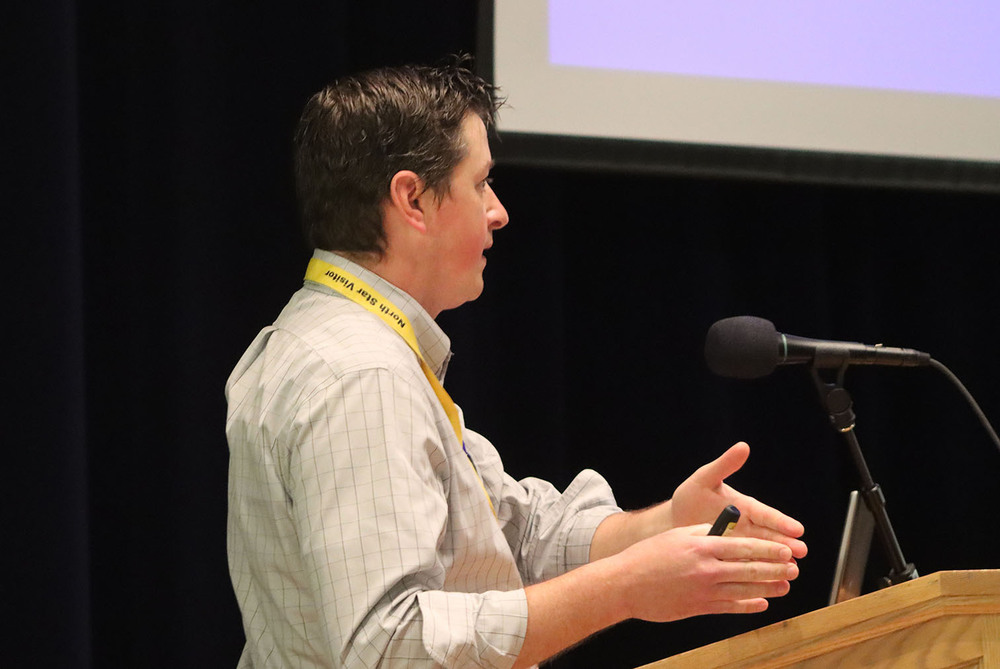
A pair of experienced professionals helped North Star High School students learn about the power of nuclear energy this spring.
Nebraska Public Power District (NPPD) employees Taylor Sutton and Jon Schulte presented information about Cooper Nuclear Station (CNS) to hundreds of Navigators. They spoke about the scientific details of the nuclear fission process to chemistry and physics students throughout the day. Sutton is the boiling water reactor vessel internals program (BWRVIP) engineer at the Brownville-based power plant, and Schulte leads energy education programs for K-12 students across the state.
North Star juniors Aurora and Anthony said they were happy to have listened to the presentation. Sutton and Schulte talked about the history of CNS, how the reactor is refueled and the chemical and engineering processes involved in generating electricity. Students also watched time-lapse videos that showed how CNS employees refuel and store fuel rods inside the structure.
“I feel like I learned a lot,” Aurora said. “It was really interesting to see how the public power system works in Nebraska and how nuclear energy is involved in that.”
“The technology that’s involved with nuclear energy today is pretty amazing,” Anthony said. “I was impressed by that.”
North Star science teacher Olivia DeFord Quiroz was grateful to have Sutton and Schulte on campus. She asked the NPPD team to come to North Star as part of a nuclear chemistry unit. Students explored the technology in their Chemistry, Advanced Placement (AP) Chemistry, Differentiated Chemistry and Environmental Chemistry courses. Several physics classes also attended the NPPD presentations.
“Many people are not aware that Nebraska gets around 16 percent of our power from nuclear energy, so this opportunity will allow students to see the reality of nuclear power and how it relates to their daily lives as part of the high school chemistry curriculum,” DeFord Quiroz said.
The Navigators prepared for the visit by examining the science surrounding fission and fusion. Fission and fusion are two types of possible chemical processes involved in nuclear reactors. They also learned how different physical elements of isotopes change or decay to produce energy, and they looked at the advantages and disadvantages of nuclear technologies.
Sutton said he was excited to share the CNS story with so many high school students. He said that type of community engagement was one of the primary reasons he was interested in coming to North Star.
“I’ve presented to college students before, but this is the first time I’ve presented to this age group,” Sutton said. “It’s been fun. It’s a great chance to spread awareness about what we do.”
CNS is one of 57 commercially operated nuclear power plants in the United States. Twenty-eight states are home to the technology, which produced 18 percent of the country’s total electricity in 2025.
Sutton said CNS immediately began impacting NPPD’s electrical grid when it began operating on July 1, 1974. Today, the plant’s nuclear fission process has a generating capacity of 835 megawatts, which is enough energy to power up to 385,000 homes. A single uranium pellet the size of a pencil eraser contains the same amount of energy as 17,000 cubic feet of natural gas, one ton of coal or 149 gallons of oil.
“It’s a huge piece of NPPD’s portfolio,” Sutton said.
Sutton said many nuclear power plants split uranium atoms inside a reactor. The heat produced from that fission is used to produce steam, which spins a turbine to generate electricity.
CNS uses a boiling water reactor design. The framework contains a reactor vessel, spent fuel pool, steel containment vessel and primary and secondary containment layers. Boiling water surrounds the nuclear fuel and heats it directly into steam inside the reactor vessel. The steam then serves as a transportation mode for the energy to travel from a turbine to a generator. The electricity is later available to Nebraska residents’ homes, farms and businesses.
DeFord Quiroz said CNS has built a reputation for prioritizing community education about nuclear power. She said the presentation’s top-notch level was just as good as advertised.
“Cooper Nuclear has some of the best, if not the best, community education outreach for nuclear power stations globally,” DeFord Quiroz said.
Aurora said she had a personal interest in discovering how CNS operates. Her grandfather, mother and aunt have all worked at the nuclear plant in various capacities. CNS currently has more than 650 employees in jobs ranging from engineering to chemistry to security.
“It’s been great learning more about their workplace,” Aurora said. “Now I have a better idea of their jobs.”
Anthony said the visit had inspired him to consider joining Aurora’s grandfather, mother and aunt in that line of work. He stayed after class to speak to Sutton and Schulte about the future possibilities. He said he was looking forward to learning more about the power of nuclear chemistry during his LPS career.
“Plan one right now is aviation, but this is definitely something worth taking a look at,” Anthony said. “It’s been really interesting.”
Do you have a story idea? Share it with the LPS Communications Team by filling out this form!